


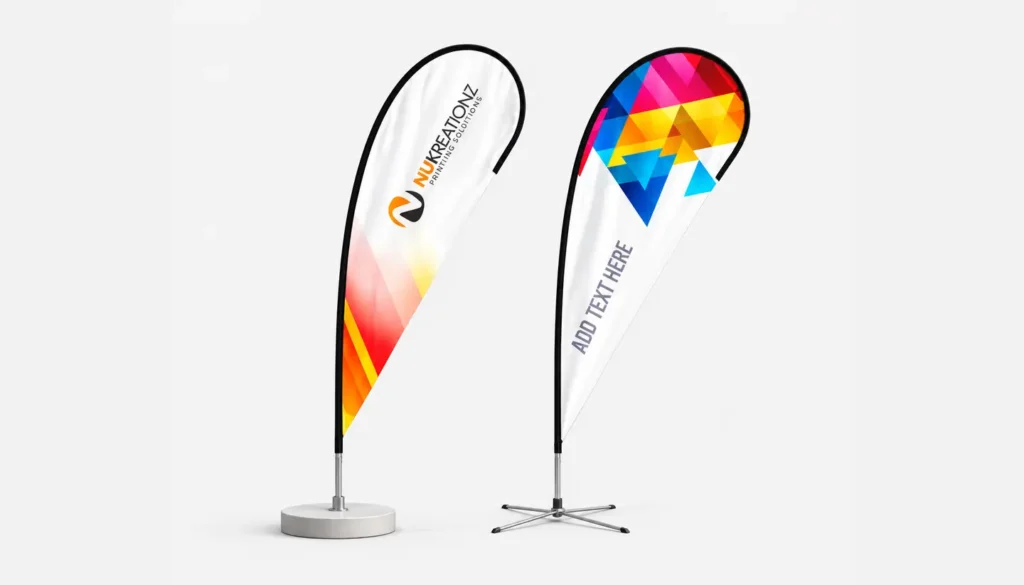
Trade show flags are a lot easier to get some use out of when the pole, the base and the branding artwork all stick to the same tried & true formula, while the fabric art that’s specific to the sponsor comes and goes between events. Before you even start printing, though, you gotta confirm that the rig is still compatible, that the venue will allow it, and that you’ve got the sponsor’s seal of approval.
Having a clear inventory and a firm deadline for getting the artwork to us helps avoid the kinds of headaches that come with mismatched sleeves, out of date logos, and having to replace things that don’t need replacing.
An exhibition team may zip from Dubai to Abu Dhabi in a matter of weeks while sponsors are coming and going long before the campaign even gets off the ground. Ordering up a whole new flag kit every time is a waste of resources, plain and simple. Custom flags printing works a lot better when you figure the fabric is an expendable item, something that can be swapped out as needed and that the hardware is treated as the valuable asset it is.
Separate Your Permanent Branding From the Stuff That’s Going to Be Changing Around
Keep your logo, your colours, and the basic message all the same from show to show, and then just stick the event dates, partner logos, and all that other stuff on the fabric graphics that can be swapped out. Unless that one sponsor is locked in for every single show, there’s no need to print them permanently into the design.
Give Those Sponsor Logos a Designated Home
Reserve a little corner of the display for changing partners. Send the sponsors the lowdown on what sorts of logo formats and colours we can work with, and what the deadline is for getting their approval on the layout. And make it clear that the final say is going to rest with us otherwise you end up with a mess of a display that nobody can even read from across the aisle. Take a step back and have a look at a scaledup print when you get a chance. A screen view can sometimes hide the fact that the lettering is just too small to be legible in a crowded exhibition space.
Keep Track of Which Artwork Is Approved
Label the files by event, by flag shape, by sponsor (and by the date it was printed). And if you’ve got an earlier proof that’s no longer good to go, mark it as superseded. When it comes to custom flags printing, the approved file has to show us the finished dimensions, the orientation, and how the reverse side is going to look. A quick snap on your phone is not going to cut it as a final production master.
Treat the Pole, the Base and the Sleeves as Part of One System
The fabric might be easy to swap out, but if it’s not the right size for that particular pole, then you’re back to square one. Different types of flags feather, sail, blade and teardrop all have their own unique curves and tension requirements. And just because you’ve got a pole that’s the same height as another one, that doesn’t mean they’re going to be interchangeable. Keep a template on file for every single hardware model you’ve got.
Record What Makes the Sleeves Fit
Take a good hard look at the assembled height, the sleeve width, the curve of the tip, the attachment ties and the usable artwork space. Get some photos of the connectors and the base fittings while you’re at it. If you’re changing suppliers, order a sample that’s been sewn up properly. You don’t want to have to deal with fabric that’s too tight and splitting at the seams; on the other hand, you don’t want fabric that’s too loose and just looks unsightly.
Choose Your Bases With the Venue in Mind
If you’re setting up indoors, go for bases that are stable and low to the ground. The last thing you want to do is block a walkway. Outdoors though, you may need to go with different weights or approved fixings. Ground spikes are a definite no go for exhibition hall floors. Double check that the whole assembly is going to be okay in the space you’ve got before you even start unloading it. Portability is one thing, but it’s not the same as being stable in a strong wind.
Which Components Should Be Reused?
| Component | Reuse across events? | Nextshow check |
| Pole and connectors | Yes, if undamaged | Model and joint fit |
| Suitable weighted base | Yes, if venueapproved | Stability and footprint |
| Core brand fabric | When details remain valid | Stitching and fading |
| Sponsorspecific fabric | Change with sponsor | Approval and sleeve fit |
Count spare fabric panels separately from complete pole kits. This helps procurement reorder graphics without buying duplicate bases and lets installation teams identify missing components before dispatch.
Specify Fabric and Two Sided Readability
Knitted polyester is a common goto for event flags because it stays flexible unlike some of the other options. When stitching reinforced hems and pole pockets, double-check them carefully, especially when assembling the same design multiple times. Consider all factors related to exposure to the outdoors; unexpected issues can arise due to cleaning requirements. Confirm these for the specific fabric you’re using instead of assuming that all polyester behaves identically.
Single layer flags tend to show a lighter, mirrored version on the back. But if a sponsor name needs to read correctly from both aisles, you’re going to want to specify a true double sided construction with a decent separating layer. This is a game changer for flags printing in Dubai where exhibition stands are often viewed from opposite directions.
Flags Printing Online: Approval and Venue Checks
Before you start getting too attached to a certain flag size or position, take the time to read the event organiser’s current exhibitor manual of custom flags printing in Dubai. The Dubai World Trade Centre has a special exhibitor guidance that tells you about specific requirements for each event you’ll be attending. Display boundaries, what materials are permitted and fire performance documentation can be really different between events. You can’t assume a forecourt setup is going to cut it inside an exhibition hall.
Get two approval checks in place : one for size, footprint and material specs, and then a written signoff on each sponsor design. When we do flag printing online, I like to make sure to send an approved production file alongside a diagram showing exactly where each flag is going. If there are any changes after the initial approval, we need to get a new version number and do a feasibility check to make sure we can still make it happen.
Schedule Installation, Returns and Storage
Make a list of each event’s fabric design, pole model, base, quantity, stand number and who’ll be installing. When packing up, try to keep matched components together, rather than just tossing them all in the same bag. Take a photo of the first assembled display so that later crews have a reference to work from.
When you take it all back down, give the sleeves a once over for fraying, poles for bends and bases for damaged connections. If the fabric gets damp, dry it out before storing it. Keep your retired sponsor graphics separate from the active inventory if you don’t want an outdated logo showing up at the next exhibition. Give each kit a number and record who took it, what came back and which parts need repair before the next booking.
Quote Reprints Apart From Complete Flag Kits
When we do custom flags printing online, we want to make sure we’re charging customers separately for fabric graphics, finishing, fitting samples, hardware and delivery. It’s not worth it to save a buck on the print cost if the sleeve needs alterations or the shipment misses setup day. Let’s plan sponsor approvals around some realistic production cutoffs.
For flags printing online across several of the UAE exhibitions, give your suppliers the event calendar and likely sponsor change dates. When we do flags printing in Dubai, Color Print’s got a pretty good selection of flags including blade, sail and teardrop options. Just make sure to confirm the construction you choose will fit your existing poles before you go buying new ones.
Frequently Asked Questions
Can new flag fabric fit an existing pole?
Usually, but you gotta check the pole profile, sleeve dimensions and attachment points against the new design to be sure.
Should sponsors appear on permanent flags?
Only when those partnerships are going to stay in place across events. Replaceable graphics can make reprinting a whole lot easier when the sponsor lineups change.
Do exhibition flags always need double sided printing?
No unless you need the sponsors to be visible from both sides, then just check if the heavier fabric will be okay for the pole.
What does a repeat order supplier need from us?
Just approved artwork, original dimensions, pole details, finishing spec, quantity and delivery deadline.
Conclusion
A repeatable tradeshow programme needs controlled sponsor artwork and reliable hardware records. With custom flags printing online, retain suitable poles and bases and replace fabric only when messages change. This reduces mismatches and makes spending across events easier to plan.