

Custom labels for food packaging need to do three things well: carry the required text, survive the conditions the product lives in, and sell the food at a glance. In Dubai, start with Dubai Municipality’s food label assessment guide, choose paper, vinyl, or clear stock to suit the product, and test one label before you print the full run.
Say you’ve finally perfected a chili sauce. The recipe took months. The label gets an afternoon, and it’s the first thing anyone reads. Then comes the awkward question: how much do custom labels cost? The honest answer has a few moving parts, and we cover it below.
This guide is for food brands selling in the UAE. It covers what goes on the label, layout, materials, cost, and testing, from Color Print, a team that prints labels and stickers for food and drink products.
What Goes on Custom Labels for Food Packaging?
More than most people plan for. Before you think about colors or fonts, list the text the label is expected to carry.
For a concrete checklist, go to the source. Dubai Municipality’s guide to food label assessment lists the trade name and product description, net content, storage conditions, ingredients, country of origin, and the name and address of the manufacturer or packer. It also requires an expiration date. Importing food? The U.S. Commercial Service’s UAE labeling guide provides its own list of minimum items, including instructions for use and, where applicable, nutritional information.
Language shapes the whole layout. Dubai Municipality’s guide says Arabic is mandatory and English is optional. For imported food, the U.S. Commercial Service guide says labels must be in Arabic only, or in Arabic and English. Plan for the Arabic text from the start, and for English too if you’re including it, because two languages take more room than one.
Also check whether your product needs allergen information, a batch or lot number, or a barcode for retail. Requirements vary by product and can change, so confirm the current rules with the relevant authority before anything goes to print.
Lay Out the Text First
Here’s a habit that can save a reprint. Write out every line the label must carry, in Arabic and in English if you’re adding it, then fit the logo around it. A label that looks great but squeezes the ingredients into a smudge has failed at its second job.
Two things get forgotten a lot. The first is room for the date. Expiry dates and batch numbers usually change with every production run, so they’re stamped on later. Leave a blank patch for them. The second is a back label. Can’t fit everything on the front? Don’t cram it. Let the front do the selling and move the ingredients, nutrition and other details to the back.
Got a draft? Print it at actual size and hold it against the real jar or box. Read it from arm’s length. If you have to squint, make it bigger or cut it. And keep anything important away from the edges, because a curve or a trim can swallow it.
Make the Front Label Do the Selling
Your front label has one job: tell people what the food is and why they’d want it. The product name comes first, in the largest type. Then add the one thing that sets it apart, such as the flavor, where it’s from, or how hot it is.
If your range has several flavors, give each one its own color but keep the same design. A row of six jars then looks like one family, and the mild one is easy to spot.
Match the Label Material to the Food
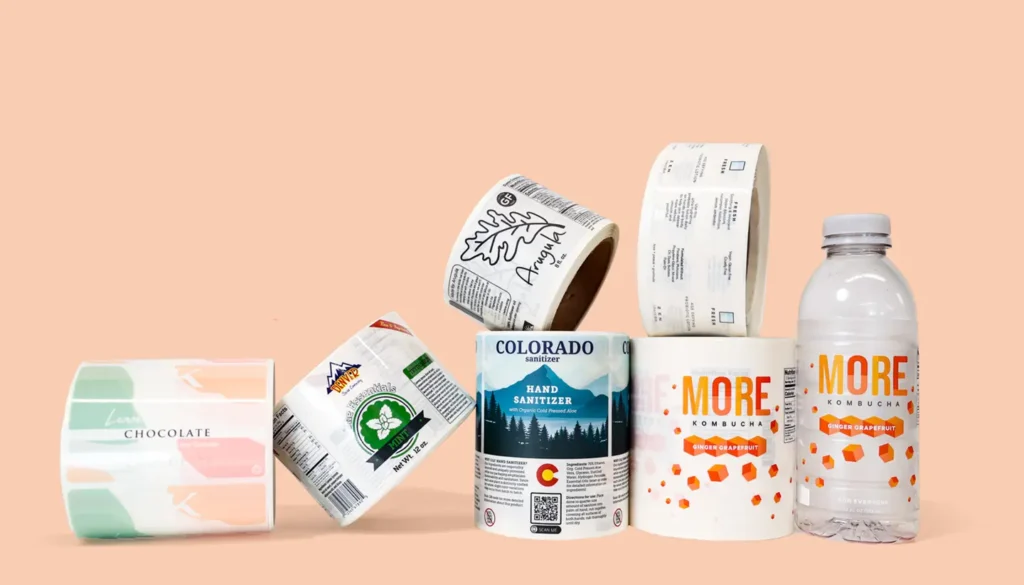
Between the kitchen and the customer, a jar gets chilled, splashed, and sometimes left in the sun. Custom labels for food packaging have to survive all of that and still look good. The table pairs common situations with the best option to ask about.
| Product or condition | Option to ask about | Why |
| Spices, snacks, dry goods | Paper | Suits products that stay dry |
| Sauces, honey, jarred food | Vinyl | Copes with moisture |
| Food the buyer should see | Transparent | Lets the product show through |
| Fridge or freezer items | Freezer-grade adhesive | Made for food and drink kept cold |
| Hot car, sunny shelf, summer delivery | Heat tolerance | Ask whether the material and adhesive both suit high temperatures |
| Gourmet or gift packs | Metallic or foil | Gives a premium look |
Whatever the product goes through, tell us when you order. Finish is worth a thought too. Our custom labels page lists matte or gloss, with embossing or foil as add-ons. Embossing gives a texture you can feel, and foil gives shine.
When Does Transparent Label Sticker Printing Make Sense?
Clear labels work best when you want the product to be the star. With no visible border, the jar looks printed on rather than stuck on. Our Clear Stickers page lists them for retail, food and beverage packaging, and custom-shaped bottles, jars, and boxes. It also describes them as waterproof and resistant to fading, tearing, moisture, and humidity.
There’s one catch. Whatever sits behind a clear label shows through, so dark sauce and pale honey will make the same ink look different. Clear also suits labels with little text, since a long ingredient list over a busy background is harder to read.
Tell the team whether you’re labeling glass, plastic, or card, because adhesive strength should match the surface.
How Much Do Custom Labels Cost?
Custom labels for food packaging don’t have a single price because a label isn’t one thing. Size, quantity, material, finish, and shape all feed into the price. A plain paper rectangle is a different job from a die-cut clear label with foil.
Custom labels can still be cost-effective: bulk printing lowers the cost per label, and durable material means fewer replacements.
To get a real figure, open the product page and fill in the quote form. Add your contact details and a short note about the job, such as size, quantity, material, and finish, and attach your artwork if it’s ready. For a whole range of flavors, ask about bulk pricing through the Get a Quote page or on WhatsApp. Comparing two quotes? Compare like with like: same size, quantity, and material.
Test One Label Before You Print the Run
Before you commit to a full run of custom labels for food packaging, ask for a physical proof so you can approve the color before production starts. Then run a few dull, useful tests, ideally on a sample of the material you’ve chosen. Stick it on a real jar or box, leave it where the product will live, and look again tomorrow. Fridge product? Fridge it. Sold through the summer? Leave it somewhere warm. Likely to meet sticky fingers? Wipe it with a damp cloth. With a clear label, hold it against the actual food. If the corners lift or the ink smears, you’ll know before the whole run is printed.
Questions Food Brands Ask About Labels
Do food labels in the UAE need Arabic text?
Yes, for food assessed by Dubai Municipality, where Arabic is the mandatory language. Imported products can carry an Arabic sticker, according to the U.S. Commercial Service, but UAE authorities need to approve it first.
Can custom labels for food packaging have a custom shape?
Yes. Die-cut labels create unique outlines, and our Clear Stickers page lists custom sizing and die-cut shapes. A round label for a jar lid is easy to picture, but confirm the outline with the team first.
Can I ask for eco-friendly materials?
Our Clear Stickers page says eco-conscious material options are available on request. Ask the team which labels these cover.
How do I choose the right label size?
Measure the flat part of the container, not its full height. Jars and bottles often curve or taper near the top and bottom, and a label there can wrinkle or lift. For a wrap-around label, ask the team how the two ends should meet.
How long does delivery take?
The product pages list an estimated delivery of 2 to 3 business days. Leave extra time for the proof and your own tests before a launch date.
Before You Brief the Printer
Get these four items before you begin: label text in full (Arabic with English if added), environment in which the product exists, quantity estimate, and a copy of artwork that is clear and unmounted.
On artwork, Dubai Municipality’s assessment guide describes the label image as the sticker artwork showing all of the item’s details, and prefers one that’s straight, not rotated. A tidy file also makes reorders quicker when a recipe changes.
Not sure where to start? Food Labels covers snacks, sauces, and gourmet products; Jar Labels covers honey and sauces; and Beverage Labels is for bottles.
With these details ready, choosing a material and adhesive is easier, and your quote comes back faster. Custom labels for food packaging only work when people can read them, so your next step is a full-size test print on the real jar.
Want to order your customized label today? Contact Color Print on WhatsApp or at +971 4 553 9967. Leaning toward transparent label sticker printing? Mention it when you get in touch, and the team can suggest the right clear stock.